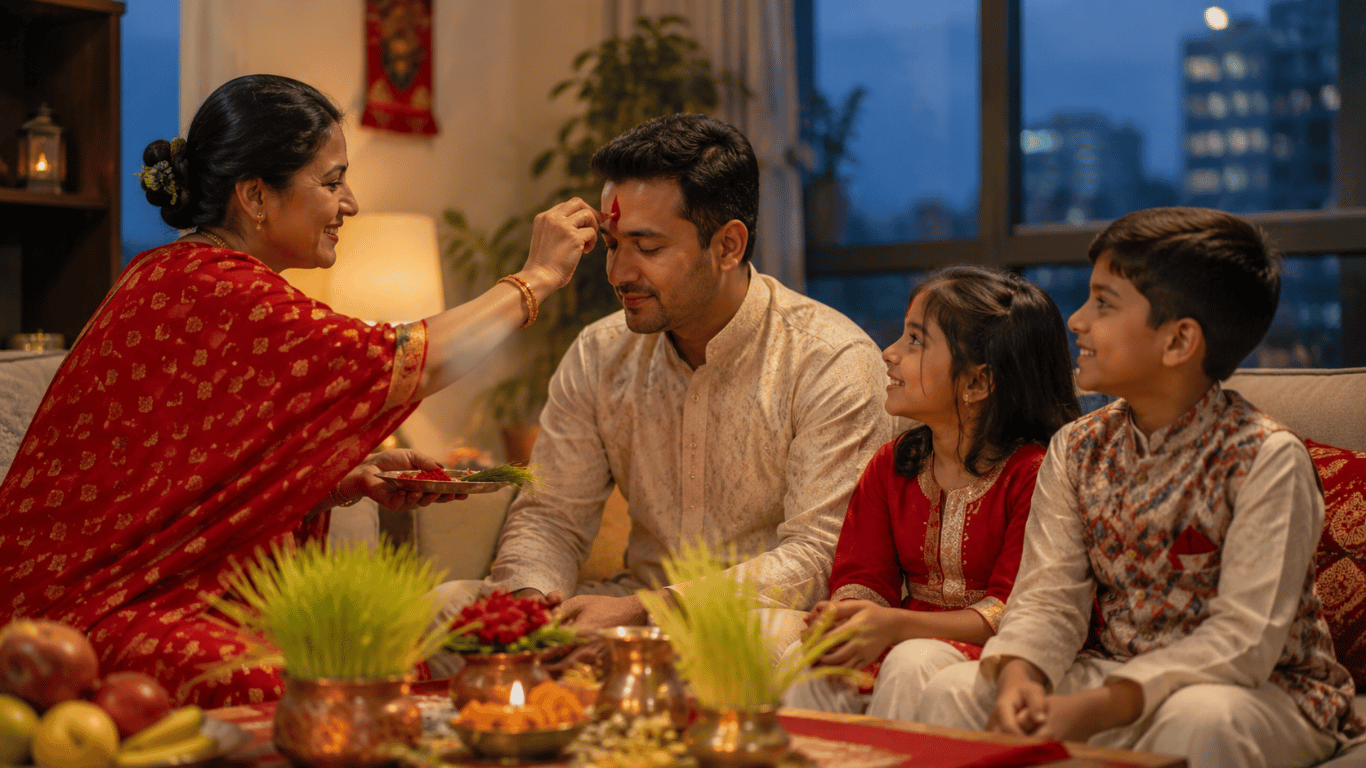
In a suburb outside Sydney, a mother is teaching her nine-year-old how to fold tika rice into a small dish. He was born in Australia and has never seen Kathmandu, but he knows that on Bijaya Dashami, his grandparents will call on video, his mother will press red tika and jamara onto his forehead, and he’ll receive an envelope of money he’s too young to fully understand yet. Across town, a small Nepali grocery store owner is deciding, three weeks out, whether to reorder puja items or take a chance on something new for the shelf near the till.
These two moments — one intimate, one commercial — sit at the heart of what Dashain becomes once a community leaves Nepal. The festival doesn’t shrink abroad. If anything, it grows more deliberate. Families who once took Dashain for granted at home now plan for it, budget for it, and use it to hand something real to children who are growing up between two cultures. What they give each other during that fortnight — and where it comes from — starts to matter more than it ever did before.
This guide is written for two audiences who are, in practice, connected: the diaspora families choosing gifts that feel true to home, and the retailers, importers and organisations who supply them. Both are asking a version of the same question — what makes a Dashain gift genuinely worth giving, and where can it reliably be sourced.
What Is Dashain, and Why Does Gifting Matter So Much?
Dashain is Nepal’s longest and most widely observed festival, marking the victory of good over evil through the goddess Durga. In 2026, the festival begins with Ghatasthapana on 11 October and builds toward its central day, Bijaya Dashami, on 21 October, when tika is applied — dates can shift slightly year to year because the festival follows the lunar calendar, so it’s worth confirming against the current Nepali Patro closer to the time. For fifteen days, extended families gather, debts are settled, homes are cleaned, and elders bless younger relatives.
Gifting during Dashain isn’t a side activity — it’s built into the ritual itself. Dakshina (money placed with tika) is a form of blessing, not a transaction. Clothes, sweets and household items exchanged between relatives carry an expectation of renewal: everyone should enter the new year a little better provided for than before.
The Meaning Behind Tika and Jamara
Tika — a mixture of rice, yoghurt and vermilion — is placed on the forehead by an elder, moving down the family hierarchy from grandparents to parents to children. Jamara, barley shoots grown in darkness for the ten days leading up to Bijaya Dashami, is tucked behind the ear or into hair alongside the tika. Together they represent fertility, growth and the continuity of the family line. Understanding this is useful context for anyone choosing a gift: the occasion is fundamentally about blessing and continuity, not consumption, which is why thoughtful, lasting items tend to mean more than disposable ones.
How Nepali Families Abroad Keep the Tradition Alive
For families overseas, Dashain requires more intention than it does in Nepal, where the festival more or less organises itself around you. Abroad, someone has to source jamara seeds, book leave from work for Bijaya Dashami, coordinate a time zone-friendly video call with grandparents, and decide how to explain the rituals to children who didn’t grow up watching them. Community organisations — Nepali associations, temples, student unions, university cultural clubs — increasingly step in to host group celebrations, which has created a genuine, if under-served, market for authentic Nepali products in cities with almost no Nepali retail infrastructure at all.
Why Authentic, Nepal-Made Gifts Matter More Than Imitations
The Problem with Mass-Produced “Nepali-Style” Products
Search for “Nepali gifts” on any large marketplace, and you’ll find a mix of genuinely handmade items sitting alongside factory-printed products with vaguely Himalayan branding, made nowhere near Nepal. For a diaspora buyer, the difference is not academic. A gift meant to connect a child to their grandparents’ homeland loses its purpose if it was never made there. And for a retailer, selling items with no verifiable origin is a reputational risk with a community that generally knows the difference and talks to each other.
What Actually Makes a Gift Authentic
Authenticity, in practical terms, comes down to three things: the materials are genuinely Nepali (Lokta bark, cotton, jute, bamboo, local wool), the production happens in Nepal by Nepali artisans or manufacturers, and the supplier can actually demonstrate this — through traceable sourcing, direct relationships with producers, or membership in recognised trade bodies such as the Federation of Handicraft Associations of Nepal (FHAN). None of this needs to be complicated to communicate. A short, honest sentence about where and how something was made usually does more for a buyer’s confidence than any amount of decorative language.
“A gift that carries a real story from Nepal — who made it, and from what — tends to be kept long after a mass-produced item has been forgotten.”
The Case for Sustainable Gifting This Dashain
Sustainability and authenticity overlap more than people expect. Materials that are genuinely Nepali also tend to be the same materials that have the lightest environmental footprint, because they were shaped by centuries of resource-conscious craft rather than industrial convenience.
Materials That Carry Meaning: Lokta Paper, Bamboo, Cotton and Jute
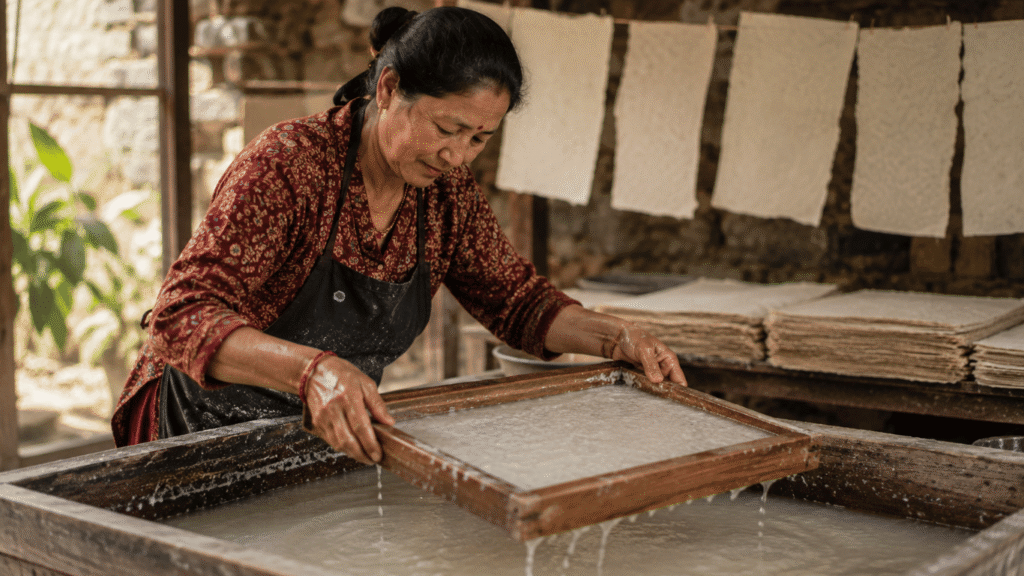
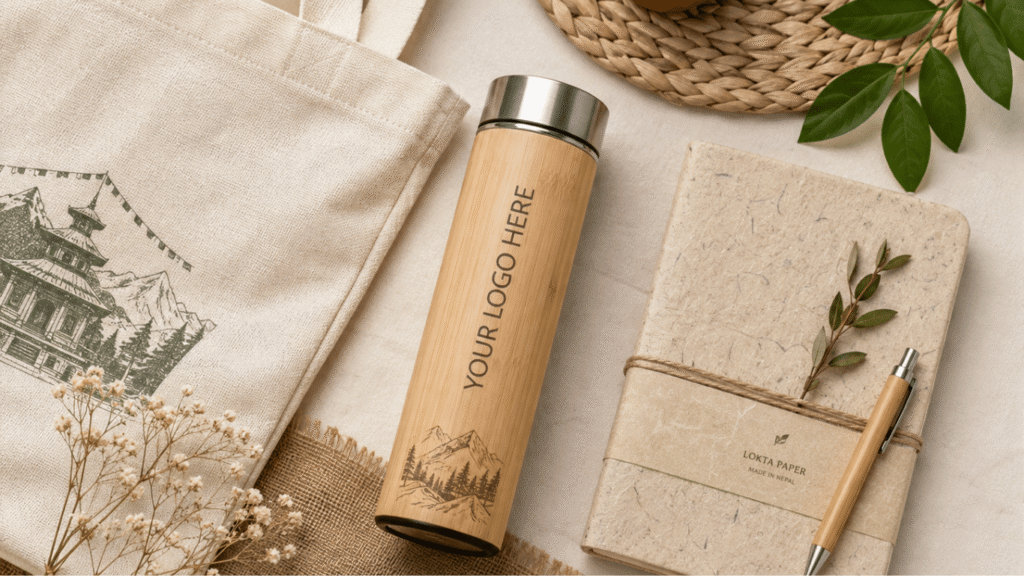
Lokta paper is one of Nepal’s clearest examples of sustainability that predates the word. Made from the bark of the Lokta shrub, which regenerates naturally within five to seven years of harvesting, the paper has been produced in the Himalayan mountains since at least the twelfth century, historically used for government and religious documents because of its resistance to insects and decay. Today it’s the material behind journals, notebooks, greeting cards and gift wrap — and it remains a significant source of income for women’s cooperatives in Nepal’s rural hill districts, many of which were established with support from development programmes in the 1980s and 1990s.
Bamboo drinkware and bottles offer a practical, reusable alternative to single-use plastics, and bamboo itself is one of the fastest-renewing plants used in manufacturing. Cotton and jute tote bags, meanwhile, double as a quiet piece of advertising for reusable habits — genuinely useful well past Dashain, whether for groceries, laptops, or as a conference giveaway that doesn’t end up in a landfill within a week.
Practical takeaway for gift-givers: a sustainable Dashain gift doesn’t need to announce itself as “eco-friendly.” The best ones simply are, by virtue of the materials and the way they were made.
Supporting Artisan Livelihoods, Not Just Buying a Product
Nepal’s handicraft sector employs more than 1.1 million people, according to FHAN, and roughly 40% of the federation’s members are women — many running micro-enterprises rather than working as employees. Handicraft exports reached approximately NPR 12 billion in 2023, having grown at a compound annual rate of around 16% over the previous decade, according to figures reported via Nepal’s Trade and Export Promotion Centre (TEPC). These aren’t abstract statistics. Every tote bag, notebook or bottle bought from a genuine Nepali manufacturer connects, however indirectly, to that employment base — cutters, stitchers, papermakers, dyers, and the small workshops that train the next generation of them.
For a diaspora buyer, this reframes the purchase slightly: it’s not just a gift for a relative, but a small vote for the continuation of a craft economy back home.
Best Dashain Gift Ideas for Every Recipient

For Parents, Grandparents and Close Relatives
Elders generally respond best to gifts that are useful, well-made and unmistakably Nepali — a handwoven shawl, a set of Lokta paper stationery for writing letters, or a bamboo travel mug for their morning tea. Practicality matters more here than novelty.
For Friends, Colleagues and Community Members
For people outside the immediate family — coworkers, neighbours, community members you’re including in the season without a close personal history — a modest, well-packaged gift communicates warmth without overreach. A small canvas pouch, a set of handmade cards, or a compact Lokta paper diary all work well and travel easily if you’re attending multiple gatherings.
For Children Born Outside Nepal
This is arguably the most important category and the most overlooked. A children’s gift with a story attached — a small jamara-growing kit, a picture book alongside a Lokta paper journal for them to start their own “Dashain diary,” or a soft cotton tote with their name embroidered — gives second-generation children something tactile to hold onto, which matters more for cultural continuity than most parents initially realise.
Comparison table: choosing the right Dashain gift
| Recipient | Good options | Typical price tier | Sustainability | Best sourced from |
| Grandparents / elders | Handwoven shawl, Lokta stationery set, bamboo mug | Mid–high | High | Specialist Nepali retailer or direct import |
| Parents / close relatives | Cotton tote gift set, bamboo bottle, gift box hamper | Mid | High | Nepali gift shop or online supplier |
| Friends / colleagues | Small pouch, greeting cards, compact diary | Low–mid | High | Community store, festival market stall |
| Children (diaspora-born) | Jamara kit, journal + storybook, embroidered tote | Low–mid | High | Specialist retailer with children’s range |
| Corporate / organisational gifting | Branded welcome kits, custom gift boxes, conference bags | Mid–high (bulk pricing) | High | Direct manufacturer / wholesale supplier |
A Practical Guide for Retailers: Building a Dashain Collection That Sells
Nepali grocery stores, gift shops and South Asian supermarkets abroad are often the only physical touchpoint a diaspora family has with authentic products during the festival — and the opportunity is frequently under-merchandised.
Timing Inventory Around the Festival Calendar
Because Dashain follows the lunar calendar and its dates shift each year, retailers who wait until the festival is a week away are already behind. Ordering six to eight weeks ahead — particularly for customised or imported stock — avoids the scramble that comes with air-freighting last-minute inventory at a premium.
Merchandising Through Storytelling
A shelf of unlabelled products underperforms a shelf that explains itself. A small card noting that the notebooks are handmade from Lokta bark by cooperatives in rural Nepal, or that the totes are woven from organic cotton, converts browsers into buyers far more effectively than price alone. Diaspora shoppers are often willing to pay a premium specifically because the story is credible.
Gift Sets and Bundling for Higher Basket Value
Bundling a bamboo bottle with a Lokta notebook and a small card, or building a “Dashain welcome kit” for community events, increases average order value while giving the customer a ready-made gift rather than three separate decisions to make. Community associations, temples and student unions organising Dashain events are also a distinct wholesale opportunity — many need dozens or hundreds of small gifts or welcome kits at once and are actively looking for a reliable supplier before someone else finds one first.
Sourcing and Importing Nepali Gifts: What Businesses Should Know
For retailers, NGOs, universities and corporate buyers considering importing directly from Nepal rather than through a domestic middleman, a few practical realities are worth understanding upfront.
Manufacturer vs. Middleman
Buying directly from a Nepal-based manufacturer typically means better pricing, more control over customisation, and a verifiable production story — all of which matter for organisations that need to justify sourcing decisions to donors, boards or customers. The trade-off is that it requires more upfront coordination: clearer specifications, realistic lead times, and a supplier who communicates well across time zones.
MOQs, Customization and Lead Times
Manufacturers generally work with minimum order quantities (MOQs) that make sense for their production runs — this is worth clarifying early, along with whether logos, colours or packaging can be customised without inflating the MOQ unreasonably. Lead times for handmade or semi-handmade goods (Lokta paper products in particular) are typically longer than mass-manufactured items, so building in a buffer of several weeks beyond the supplier’s quoted timeline is sound practice, especially around a fixed festival date.
Ethical Sourcing and Compliance
Buyers increasingly want assurance that products are ethically made — fair wages, safe working conditions, no child labour. The World Fair Trade Organization’s ten principles of fair trade (covering fair payment, transparency, and respect for the environment, among others) offer a useful reference framework even for buyers not seeking formal certification, since they outline the questions worth asking any supplier: How are producers paid? Is there transparency in the supply chain? What environmental standards are followed? A supplier who can answer these clearly, without deflecting, is generally the safer long-term partner.
Where Samsara Bags and Box Fits In
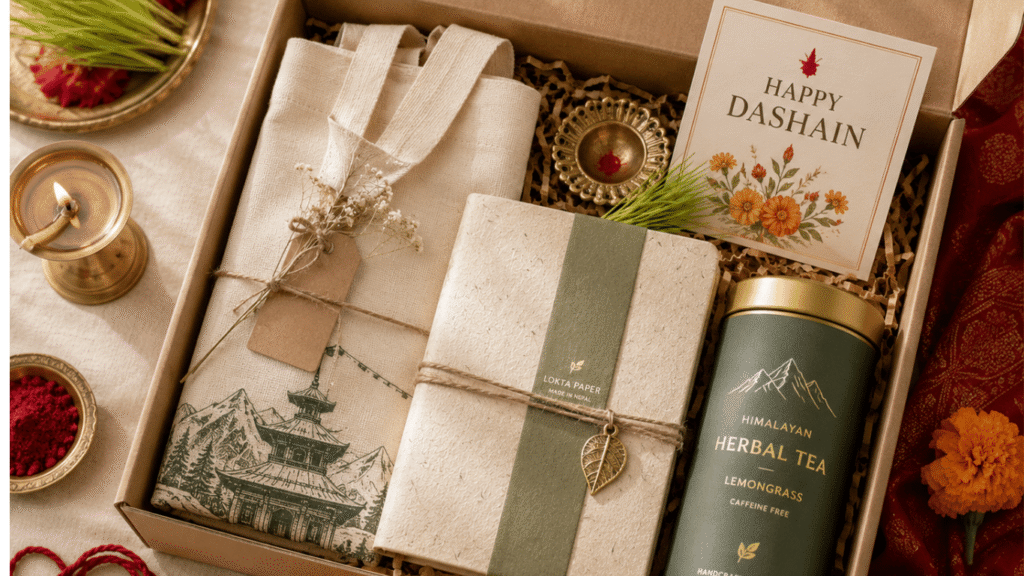
Much of what’s described above — traceable materials, direct artisan relationships, realistic MOQs, export-ready compliance — is exactly the operational territory Samsara Bags and Box works in day to day. Based in Nepal, Samsara manufactures cotton and jute tote bags, bamboo bottles and drinkware, Lokta paper journals and diaries, and customised corporate gift and welcome kits for clients that include NGOs, INGOs, UN agencies, banks, universities and event organisers. For a diaspora association planning a Dashain event, a retailer building a festival collection, or a corporate buyer sourcing sustainable gifts at scale, that combination of manufacturing capability and export readiness is often the missing piece between “we’d like authentic Nepali gifts” and actually having them on a shelf or in an event bag on time.
Organisations exploring this route are welcome to request a catalogue or start a conversation about customisation and wholesale pricing well ahead of the festival season, since production slots fill up fastest in the months before Dashain.
Key Takeaways
- Dashain gifting is rooted in blessing and continuity, not consumption — lasting, meaningful items suit the occasion better than disposable ones.
- Authenticity means Nepali materials, Nepali production, and a supplier who can demonstrate both.
- Sustainable materials like Lokta paper, bamboo, cotton and jute are not a trend in Nepal — they reflect centuries of resource-conscious craft.
- Nepal’s handicraft sector supports over 1.1 million livelihoods, with women making up roughly 40% of FHAN’s membership.
- Retailers benefit from ordering six to eight weeks ahead and merchandising with a genuine origin story.
- Importers should clarify MOQs, lead times and ethical sourcing standards early, and build in a buffer beyond quoted production timelines.
- Samsara Bags and Box manufactures and exports sustainable, customisable Dashain and corporate gift products directly from Nepal.
Frequently Asked Questions
1. What are the best Dashain gifts to send to family abroad?
Practical, well-made items with a clear connection to Nepal tend to work best — Lokta paper stationery, handwoven textiles, bamboo drinkware, or a curated gift box combining several small items. Usefulness and authenticity matter more than novelty.
2. Why does it matter if a Dashain gift is “authentic” rather than just Nepali-inspired?
Because the value of the gift, especially for diaspora families, is largely symbolic — it’s meant to connect the recipient to Nepal itself. An item genuinely made there, from local materials, by Nepali artisans, carries that connection in a way a generically branded product cannot.
3. How is Dashain celebrated by Nepali communities living abroad?
Typically through smaller-scale versions of home traditions: tika and jamara within the household (sometimes coordinated with family in Nepal via video call), community gatherings organised by Nepali associations or temples, and gift exchanges that lean more deliberately on items that feel authentically Nepali, since they’re harder to come by locally.
4. What is Lokta paper, and why is it associated with sustainability?
Lokta paper is Nepal’s traditional handmade paper, produced from the bark of the Lokta shrub, which regenerates within five to seven years of harvesting. It has been made in the Himalayan region since at least the twelfth century and remains an important income source for rural women’s cooperatives today.
5. Can a retailer or gift shop abroad buy Dashain products wholesale directly from Nepal?
Yes. Many Nepal-based manufacturers work directly with international retailers, offering wholesale pricing, customisation, and export documentation. It’s worth confirming minimum order quantities, lead times and shipping terms well in advance of the festival season.
6. How far in advance should a business order Dashain gifts or merchandise?
Because Dashain follows a shifting lunar calendar and demand spikes sharply in the weeks before it, ordering six to eight weeks ahead — earlier for customised or bulk orders — helps avoid rushed, costlier shipping.
7. What does “ethical sourcing” mean in the context of Nepali handicrafts?
It generally refers to fair payment to artisans, transparent supply chains, safe working conditions, and no child labour — principles reflected in frameworks like the World Fair Trade Organization’s ten principles of fair trade, which offer a useful checklist even for buyers not pursuing formal certification.
8. Are sustainable materials like bamboo and jute more expensive than conventional alternatives?
Not necessarily. Pricing depends more on production scale, customisation and finishing than on the raw material itself. Bulk wholesale orders of bamboo or jute products are often cost-competitive with plastic or synthetic alternatives once packaging and branding are factored in.
9. Can Dashain gift products be customised with a company or organisation’s branding?
Yes — most Nepal-based manufacturers of totes, bottles, notebooks and gift sets offer logo printing, embroidery, or custom packaging for corporate and organisational orders, typically subject to a minimum order quantity.
10. What is the difference between buying from a manufacturer directly and through a middleman or marketplace?
Buying direct generally means better pricing at volume, more control over customisation, and a verifiable production story. It requires more upfront coordination on specifications and lead times, but suits any organisation that needs to account for where its products came from.
If your organisation, store or community group is planning for Dashain and would like to discuss authentic, customisable gifts sourced directly from Nepal, Samsara Bags and Box welcomes the conversation — whether that’s a catalogue request, a small wholesale order, or a first exploratory chat about what’s possible.
7. Key Takeaways
- Dashain gifting is rooted in blessing and continuity, not consumption — lasting, meaningful items suit the occasion better than disposable ones.
- Authenticity means Nepali materials, Nepali production, and a supplier who can demonstrate both.
- Sustainable materials like Lokta paper, bamboo, cotton and jute are not a trend in Nepal — they reflect centuries of resource-conscious craft.
- Nepal’s handicraft sector supports over 1.1 million livelihoods, with women making up roughly 40% of FHAN’s membership.
- Retailers benefit from ordering six to eight weeks ahead and merchandising with a genuine origin story.
- Importers should clarify MOQs, lead times and ethical sourcing standards early, and build in a buffer beyond quoted production timelines.
- Samsara Bags and Box manufactures and exports sustainable, customisable Dashain and corporate gift products directly from Nepal.