Sustainable merchandise is an established concept, but running a business that actually lives up to it by local sourcing, fair pay for artisans, consistent quality, and reliable delivery is far more complex. Samsara has been working to address this challenge. This blog walks you through Samsara’s domestic operations, the obstacles faced, and what our long-term vision actually means in practice.
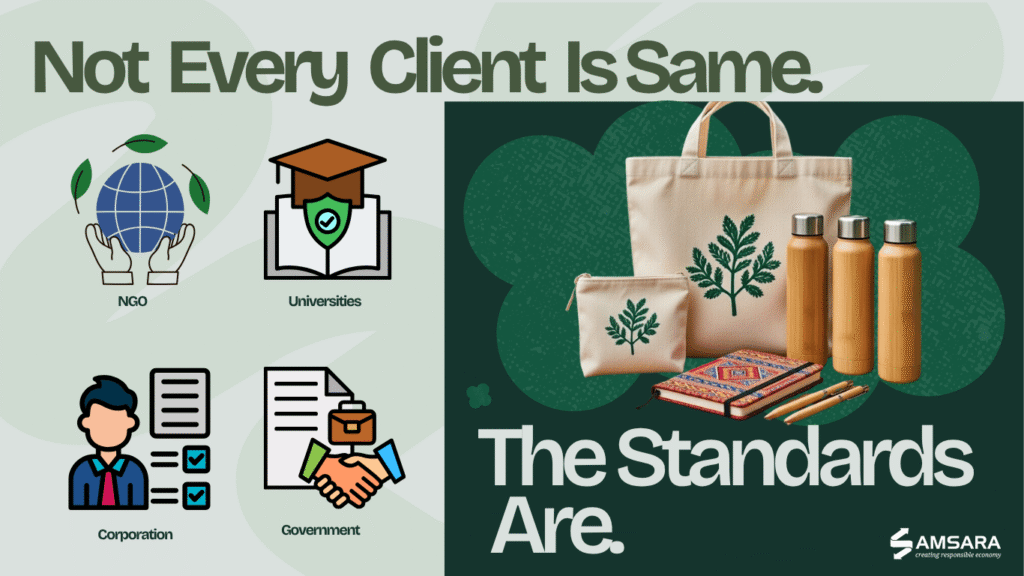
Not every client is the same; the standards are
Samsara’s client list is a diverse mix of NGOs, development organizations, universities, corporations, and government agencies, each arriving with its own priorities. NGOs emphasize social impact, academic institutions are constrained by budget, corporate clients require precise brand execution, and government bodies are governed by compliance standards and pricing frameworks. The price shifts depending on who’s in the room, but the product standards don’t. Clients on tighter budgets are pointed towards lower-cost options within a sustainable lineup. If the quoted price is below the sustainable production required, Samsara turns the order down.
On the operational side, most requests come down to logo printing, fabric choices, and customisation. MOQs, lead times, and material limits are laid out upfront with no ambiguity.
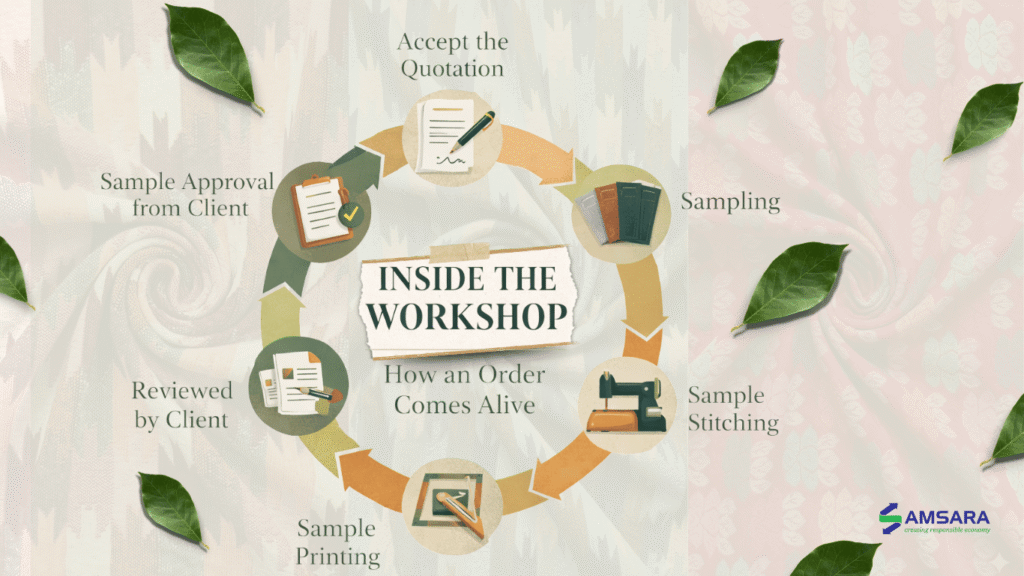
Inside the workshop: the making of an order
No order enters production until a written confirmation and accepted quotation are in hand. From there, sampling begins; fabric is stitched, printing is tested, and a sample is approved by the client before a single unit of full production is cut. The process moves through with clients updated at every stage. The standard lead time of 7 – 10 working days is not a delay; it is a deliberate minimum that protects quality and the people producing it. As Samsara’s production manager said:
“We don’t compromise the process — even when clients need it urgently”
At Samsara, quality isn’t verified at the finish line — it is maintained at every stage. Each completed piece of sustainable dhaka notebooks, totebags, bamboo bottle is individually inspected for stitching, print alignment and any defects. Additional units are produced specifically so that faulty pieces can be replaced without any delay in delivery. Samsara has never shipped an order it wasn’t confident about, it has simply absorbed the cost of getting it right.
The challenge, often overlooked
For a business built on local sourcing, Nepal’s supply chain is both the foundation and recurring obstacle. Working with locally sourced dhaka fabric, lokta paper, hemp and jute isn’t just a sourcing decision. Material runs short during certain seasons for production of lokta notebook, dhaka notebooks. Regional supply lines get interrupted. Samsara manages this by maintaining supplier relationships across multiple regions, placing advance orders, and keeping buffer stock for materials most likely to run short like bamboo bottles, dhaka notebooks. Scaling adds another layer: crafts like dhaka weaving and lokta paper-making can’t be rushed without breaking them. So instead of pushing artisans harder, the team plans earlier.
As Samsara’s Production Head puts it, the goal is traditional craftsmanship and efficient, sustainable practice working together— not one sacrificed for the other.
Trust-built order, one at a time
There’s no shortcut behind Samsara’s domestic reputation; just consistent work and honest communication, repeated over time. The organizations like USAID, NMB Bank, CNI, and Kathmandu University did not return because of a pitch. They returned because the work was delivered and their liking towards our sustainable merchandise like bamboo bottles, totebags, dhaka notebooks, lokta notebook and many more. In a market where trust is hard to build and easy to lose, word of mouth and genuine client reviews has proven to be the most effective channel Samsara has — and the one that reflects what Samsara actually stands for.